Mathpad
An addition and subtraction app for my 4- and 6-year-old, built on how children actually learn arithmetic.
FastAPI, SQLite, vanilla JS, ONNX Runtime Web
Shipped
An addition and subtraction app for my 4- and 6-year-old, built on how children actually learn arithmetic.
FastAPI, SQLite, vanilla JS, ONNX Runtime Web
An iPad math app that follows California's preschool foundations and the Common Core, from counting to subtraction within 20. Every lesson shows, guides, then lets the child try alone, with answers written by hand and every instruction spoken aloud.
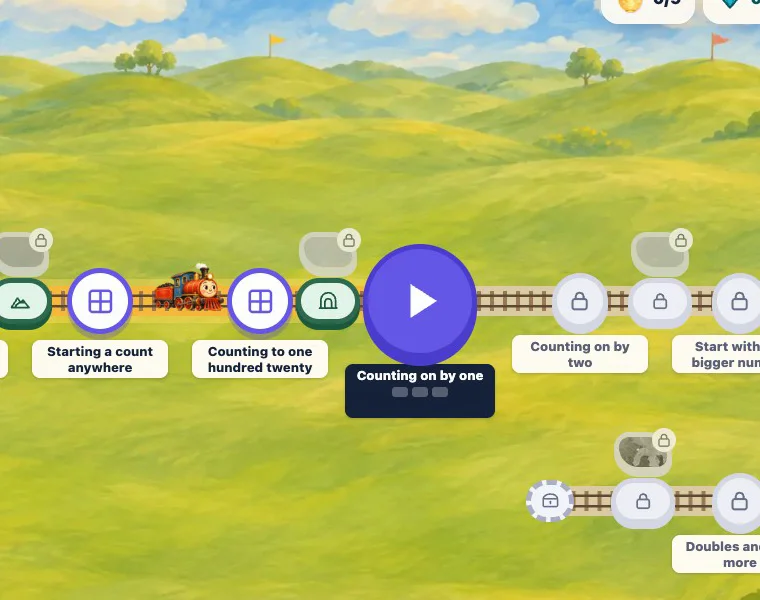
The lesson in the video is "Counting on by one", recorded with a test child profile. The app is private to my family, behind a Google sign-in.
My two kids had two different problems. My 4-year-old counted everything on fingers, even within 10, and got stuck on sums above 10. My 6-year-old could add and subtract, but stumbled on taking a large single digit away from a teen number, like 17 − 8 or 13 − 9.
The first version failed. My 4-year-old can't read yet, and the app gave text instructions. Navigation was too complex. The curriculum moved too fast, with too little repetition. There were tears. Almost everything below came from watching those sessions and rebuilding around what I saw.
A public curriculum, not a drill ladder. The spine is California's Preschool/Transitional Kindergarten Learning Foundations and the Common Core standards for kindergarten to grade 2, covering addition and subtraction within 20. I add a smaller practice step only where a standard needs finer sequencing, such as learning what the plus sign means before using it in an equation. The app has 80 classes, from counting to subtracting through ten.
Start from what the child can already do. Placement comes from observing the child, not from which worksheet they were last given. For my 4-year-old, the first question is whether the child counts everything or counts on: given 3 + 2 and 2 + 5, do they start again from one? From there the sequence is counting on by one within 5 and then 10, counting on by two, starting with the bigger number, parts of five, number bonds and doubles. For my 6-year-old, the app first checks the pieces a teen subtraction depends on (16 = 10 + ?, 16 − 6, 16 − 10, 9 + ? = 16) before choosing a strategy. Then it teaches one route at a time: count up through ten (for 17 − 8, count 8 → 10 → 17, so 2 + 7) or subtract through ten.
Every lesson follows the same arc: a worked example, guided practice, less support, working independently, a new kind of problem (transfer), then review days later. This follows the What Works Clearinghouse practice guides on early mathematics and math intervention: explicit instruction, connected representations and guided practice. The worked example performs the mathematics on screen (a dot jumps one step along the number line), then the child makes the same jump before writing an answer.
Symbols are taught, not assumed. "Plus means put more in." "Equals means is the same as." "Minus means take away." Each gets its own class, drawn large in its own colour and read aloud, before it appears in a problem. The blank in 3 + _ = 5 is taught as "the hiding number" (counters hidden under cups) before any problem uses one.
Mastery is measured by evidence, not speed. A step counts as learned after two guided completions, then four of the last five independent answers correct, across at least three different problems and including a transfer problem. After that it comes back for review about 1, 3, 7 and 21 days later, because spacing out practice and mixing problem types improve retention (Cepeda et al., 2006; Rohrer & Taylor, 2007). Understanding, accuracy, speed and flexibility develop together (National Research Council, Adding It Up), so a slow correct answer never counts against a child. Response time is recorded only so a parent can see it. A failed review brings targeted practice, not a reset to the start.
Mistakes lead to help, not failure. A missed question comes back later in the lesson, up to twice. Two misses in three questions bring a fresh demonstration and an easier guided example. If the child is still stuck, the lesson ends gently and asks a parent to watch the next attempt. A class finished with less than 75% right on the first try adds a "treasure stone" to replay together, a gift on the map, never a lock. There are no timers, no correctness streaks and no leaderboards, and the praise is for effort: "You kept going!"
Short sessions. About 5 minutes and 6 questions for my 4-year-old, and 8 minutes and 10 questions for my 6-year-old, with at most one new idea a day.
What this is not. These thresholds are starting defaults for a pilot with my own kids, not established cut-offs, and I adjust them from what I observe.
Teaching without words. A 4-year-old can't read "start at 3 and move right 1", so every idea needs a picture that does the mathematics: a dot that jumps, cups that lift to show what's hidden, counters that leave. Getting each worked example and hint to act it out, instead of describing it, mattered more than any other change.